Australia Women’s National Cricket Team vs India Women’s National Cricket Team stats
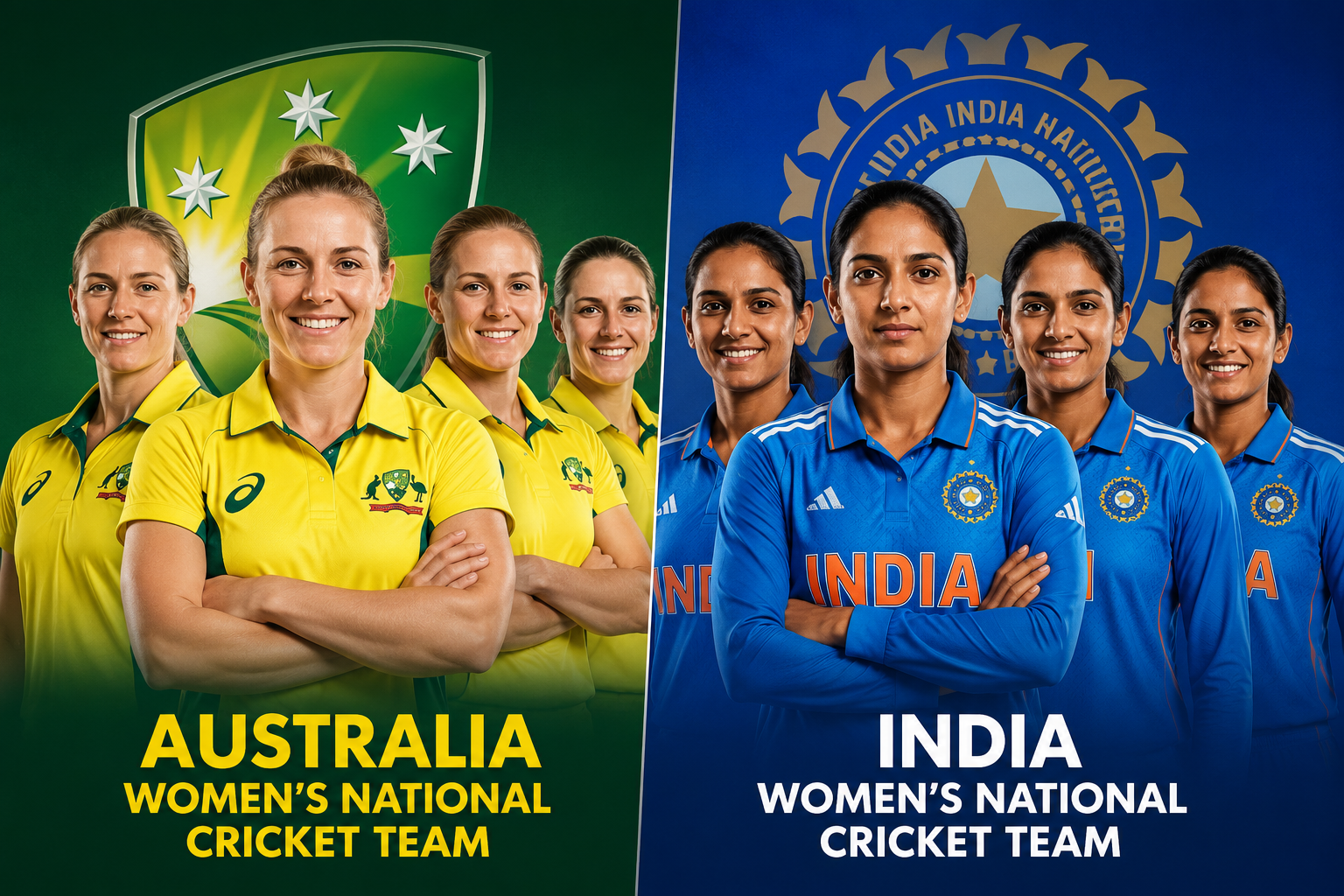
Table of Contents
The rivalry between Australia Women and India Women has grown into one of the most compelling contests in modern cricket. What began as a series of uneven encounters gradually transformed into a battle filled with skill, pressure, and unforgettable moments. Across Tests, ODIs, and T20Is, both teams have produced memorable performances that have shaped the landscape of women’s cricket. From dominant victories and dramatic chases to record-breaking innings and match-winning bowling spells, this rivalry has delivered excitement for fans around the world. Every meeting adds another chapter to a story defined by competition, resilience, and the pursuit of excellence on the international stage.
Recent Matches Table
| Match and Format | Date 2026 | Venue | Batting First Score | Batting Second Score | Match Winner | Margin |
| Only Test | March 06–08 | Perth WACA | IND-W: 198 and 149 | AUS-W: 323 and 28/0 | Australia | 10 Wickets |
| 3rd WODI | March 01 | Hobart | AUS-W: 409/7 | IND-W: 224/10 | Australia | 185 Runs |
| 2nd WODI | February 27 | Hobart | IND-W: 251/9 | AUS-W: 252/5 | Australia | 5 Wickets |
| 1st WODI | February 24 | Brisbane | IND-W: 214/10 | AUS-W: 217/4 | Australia | 6 Wickets |
| 3rd WT20I | February 21 | Adelaide | IND-W: 176/6 | AUS-W: 159/9 | India | 17 Runs |
| 2nd WT20I | February 19 | Canberra | AUS-W: 163/5 | IND-W: 144/9 | Australia | 19 Runs |
Match Overview Table
| Match Event | Format | Toss Winner | Toss Choice | Pitch Nature | Primary Boundary | Stadium Capacity |
| Perth Fixture | Test | Australia | Bowl First | Fast and Bouncy | 68 Meters | 24,500 |
| Hobart Game 2 | WODI | India | Bat First | Flat Pitch | 64 Meters | 19,500 |
| Hobart Game 1 | WODI | India | Bat First | Slow Turn | 62 Meters | 19,500 |
| Brisbane Leg | WODI | India | Bat First | Green Grass | 65 Meters | 25,000 |
| Adelaide T20 | WT20I | India | Bat First | Balanced | 60 Meters | 53,500 |
| Canberra T20 | WT20I | India | Bowl First | Batting Haven | 63 Meters | 13,500 |
Best Bowling Figures Table
| Bowler Name | Team | Match Format | Overs Bowled | Runs Given | Wickets Taken | Economy Rate |
| Sayali Satghare | IND-W | Only Test | 18.4 | 50 | 4 | 2.68 |
| Annabel Sutherland | AUS-W | Only Test | 17.0 | 46 | 4 | 2.71 |
| Lucy Hamilton | AUS-W | Only Test | 11.0 | 31 | 3 | 2.81 |
| Arundhati Reddy | IND-W | 1st WT20I | 4.0 | 18 | 4 | 4.50 |
| Darcie Brown | AUS-W | Only Test | 12.4 | 41 | 2 | 3.24 |
| Sneh Rana | IND-W | Only Test | 17.0 | 64 | 1 | 3.76 |
Statistical Comparison Table
| Performance Metric | Australia Test | India Test | Australia ODI | India ODI | Australia T20I | India T20I |
| Highest Team Score | 323 | 198 | 409/7 | 251/9 | 163/5 | 176/6 |
| Lowest Team Score | 28/0 | 149 | 217/4 | 214 | 133 | 50/1 |
| Top Individual Run | 129 | 63 | 100 plus | 70 plus | 40 plus | 50 plus |
| Total Fours Hit | 45 | 32 | 41 | 24 | 14 | 18 |
| Total Sixes Hit | 1 | 0 | 11 | 4 | 3 | 5 |
| Most Wickets Match | 6 | 4 | 4 | 3 | 3 | 4 |
Match Result and Player of the Match Table
| Match Identification | Final Scoreline | Winner | Match MVP | Top Runscorer | Top Bowler | Crucial Turning Point |
| Only Test Match | AUS 323 and 28/0 v IND 198 and 149 | AUS-W | Annabel Sutherland | A. Sutherland | S. Satghare | Sutherland first innings score |
| 3rd WODI Game | AUS 409/7 v IND 224/10 | AUS-W | Alyssa Healy | A. Healy | A. Gardner | Australia big total score |
| 2nd WODI Game | IND 251/9 v AUS 252/5 | AUS-W | Georgia Voll | G. Voll | Deepti Sharma | Voll opening batting stand |
| 1st WODI Game | IND 214/10 v AUS 217/4 | AUS-W | Beth Mooney | B. Mooney | D. Brown | Mooney unbeaten anchor knock |
| 3rd WT20I Game | IND 176/6 v AUS 159/9 | IND-W | Smriti Mandhana | S. Mandhana | Renuka Singh | Mandhana rapid powerplay runs |
| 2nd WT20I Game | AUS 163/5 v IND 144/9 | AUS-W | Georgia Voll | G. Voll | Radhay Yadav | Tight death bowling performance |
When the Gap Felt Unbridgeable
In the early phase of this cricketing rivalry, the contrast in preparation, experience, and execution was extremely visible. Australia arrived as a fully structured unit with professional systems, while India were still building consistency in international women’s cricket. The matches often reflected a one sided rhythm where Australia controlled both innings with discipline and clarity. India showed flashes of talent through individual performances, but sustaining pressure over 50 overs remained a challenge. Fielding standards, fitness levels, and tactical awareness were key areas where the difference stood out. Early encounters were less about rivalry and more about learning experiences for India against a dominant force. However, even in heavy defeats, Indian players gained exposure to elite competition, which slowly planted the seeds of future competitiveness. These matches laid the foundation of a long journey where the gap would eventually start to shrink, but at this stage, Australia clearly dictated the narrative.
| Year | Match Type | Winner | Key Moment |
| 2004 | ODI | Australia | Strong top order batting display |
| 2006 | ODI | Australia | Early bowling collapse of India |
| 2008 | ODI | Australia | Century partnership domination |
| 2010 | ODI | Australia | Controlled chase under pressure |
Rivalry Begins to Find Its Pulse
As international exposure increased, India slowly started showing signs of tactical growth and mental strength. The matches against Australia began to feel less predictable, even if results still favored the stronger side. Indian batters started building longer innings, and bowlers began to experiment with variations to break partnerships. Australia still held an edge in execution, but India’s improvement in fielding and fitness brought more balance into contests. Certain games went deeper into the second innings, creating moments where pressure shifted briefly. The rise of young Indian players added energy to the lineup, while Australia continued to rely on experience and structured game plans. These encounters became more competitive, with smaller margins deciding outcomes. Although Australia remained ahead in the win column, India had started to earn respect through fighting performances, setting the stage for a more emotionally charged phase of this sporting rivalry.
| Year | Match Type | Winner | Key Moment |
| 2011 | ODI | Australia | Tight middle overs control |
| 2012 | T20I | Australia | Late wickets under pressure |
| 2013 | ODI | Australia | Improved Indian batting resistance |
| 2014 | T20I | Australia | Narrow finish in chase |
Era of Australian Dominance
During this period, Australia operated like a well oiled machine built for consistency across formats. Their batting depth allowed them to recover even from early setbacks, while their bowling attack maintained relentless pressure throughout the innings. India often found themselves reacting rather than dictating terms. Australian players adapted quickly to conditions and exploited even small mistakes with clinical precision. The psychological edge was also significant, as Australia entered matches expecting to win, which often reflected in their calm decision making under pressure. India, on the other hand, struggled to maintain momentum after promising starts. Despite individual brilliance from Indian players, partnerships and execution gaps prevented them from converting competitive positions into victories. This phase became a benchmark for India to understand the level required to compete at the highest stage. It also highlighted the importance of long term system building in women’s cricket.
| Year | Match Type | Winner | Key Moment |
| 2015 | ODI | Australia | Dominant spin control |
| 2016 | T20I | Australia | Fast scoring powerplay |
| 2016 | ODI | Australia | Middle order stability |
| 2017 | ODI | Australia | Early wicket breakthroughs |
Mithali Raj Leadership Phase
The leadership era of Mithali Raj brought a different sense of structure and belief to the Indian side. Her calm presence at the crease and tactical understanding helped India become more competitive against top teams. Under her guidance, India began to focus on building innings rather than playing aggressive but risky cricket. This approach led to more stable performances, especially in ODIs. Matches against Australia became slightly more balanced, with India holding their own for longer periods. Mithali’s partnerships with younger batters played a crucial role in anchoring innings during pressure situations. However, Australia still maintained superiority in finishing games, often accelerating at crucial moments. Despite that, India started to believe they could challenge the best. This phase marked a transition where India stopped being intimidated and began approaching matches with strategic clarity and patience.
| Year | Match Type | Winner | Key Moment |
| 2017 | ODI | Australia | Strong opening partnership |
| 2017 | ODI | India | Competitive chase effort |
| 2018 | T20I | Australia | Death overs dominance |
| 2018 | ODI | Australia | Controlled bowling spell |
2017 World Cup Semifinal
This match became a turning point in women’s cricket history and transformed the perception of this rivalry forever. India entered the semifinal as underdogs, while Australia carried experience and dominance. However, what unfolded was one of the most explosive batting performances ever seen in knockout cricket. India posted a massive total driven by fearless stroke play and aggressive intent. The Australian chase began with confidence but quickly faced pressure as wickets fell at regular intervals. The momentum swings were dramatic, and the crowd energy reflected the tension on the field. India’s fielding intensity and bowling discipline created constant pressure. Australia fought hard but could not recover from early setbacks. The match became a defining moment that proved India could not only compete but also dominate on the biggest stage. It changed the emotional balance of the rivalry permanently.
| Year | Match Type | Winner | Key Moment |
| 2017 | World Cup SF | India | Massive batting total |
| 2017 | World Cup SF | India | Middle overs acceleration |
| 2017 | World Cup SF | India | Early Australian wickets |
| 2017 | World Cup SF | India | Historic knockout win |
Modern Competitive Era
In the modern phase, the rivalry has become far more balanced and emotionally charged. Both teams now feature world class players with the ability to change matches within a few overs. India’s batting lineup has grown stronger with more aggressive intent, while Australia continues to rely on depth and tactical intelligence. Matches between these sides are now decided by small moments rather than long periods of dominance. Fielding standards from both teams are elite, and fitness levels have reached similar benchmarks. Australia still holds a slight edge in consistency, but India has closed the gap significantly. Every series now carries higher stakes, and fans expect close finishes. Tactical innovations such as flexible batting orders and specialized bowling plans have added complexity to these contests. The rivalry has evolved into a true global highlight in women’s cricket.
| Year | Match Type | Winner | Key Moment |
| 2019 | T20I | Australia | Power hitting finish |
| 2020 | T20I | Australia | Strong final performance |
| 2021 | ODI | Australia | Bowling discipline |
| 2022 | T20I | India | Balanced chase effort |
Big Match Finals and ICC Events
In major ICC tournaments and finals, the pressure between these two teams reaches its peak. Australia often brings unmatched experience in knockout situations, while India relies on momentum and individual brilliance. Matches in finals are usually decided by execution in the final ten overs, where Australia’s calm approach often makes the difference. However, India has also produced memorable performances that challenged Australian dominance. The Commonwealth Games and World Cup encounters added new chapters to this rivalry, showing how far Indian cricket has progressed. Tactical planning becomes more detailed in these matches, with captains adjusting strategies ball by ball. Fans from both sides treat these games as emotional battles rather than just sporting events. The rivalry in big tournaments has elevated women’s cricket globally and created some of the most memorable moments in recent history.
| Year | Match Type | Winner | Key Moment |
| 2020 | T20 World Cup Final | Australia | Early wicket pressure |
| 2022 | Commonwealth Games Final | Australia | Chase control finish |
| 2023 | T20I Series | Australia | Consistent batting depth |
| 2024 | ODI Series | India | Competitive series performance |
Conclusion
Over the years, this rivalry has evolved from a one-sided contest into a highly anticipated clash between two world-class teams. Both sides have contributed iconic performances, legendary players, and unforgettable matches that continue to inspire cricket fans globally. While one team established an early advantage through consistency and depth, the other steadily closed the gap through determination and emerging talent. The result is a rivalry built on respect, intensity, and high standards. As new generations of players step forward, future encounters promise even more drama, tactical battles, and historic moments that will further strengthen the legacy of this remarkable cricketing rivalry.
Frequently Asked Questions
Which team has historically performed better in this rivalry?
Australia has generally enjoyed greater success across formats, benefiting from strong squad depth, consistent performances, and a long-standing winning culture.
What is the most memorable match between these teams?
Many fans consider the 2017 Women’s World Cup semifinal one of the most memorable encounters due to its high stakes and remarkable individual performances.
Which players have had the biggest impact on this rivalry?
Several players have shaped this contest through the years, including Mithali Raj, Harmanpreet Kaur, Smriti Mandhana, Meg Lanning, Ellyse Perry, and Alyssa Healy.
Why is this rivalry important in women’s cricket?
The rivalry showcases two of the strongest teams in the sport and has played a major role in increasing global interest and viewership for women’s cricket.
What makes matches between these teams so competitive today?
Improved player development, tactical awareness, stronger domestic structures, and world-class talent on both sides have made recent contests far more competitive and unpredictable.


Post Comment