India Women’s National Cricket Team vs Australia Women’s National Cricket Team Timeline
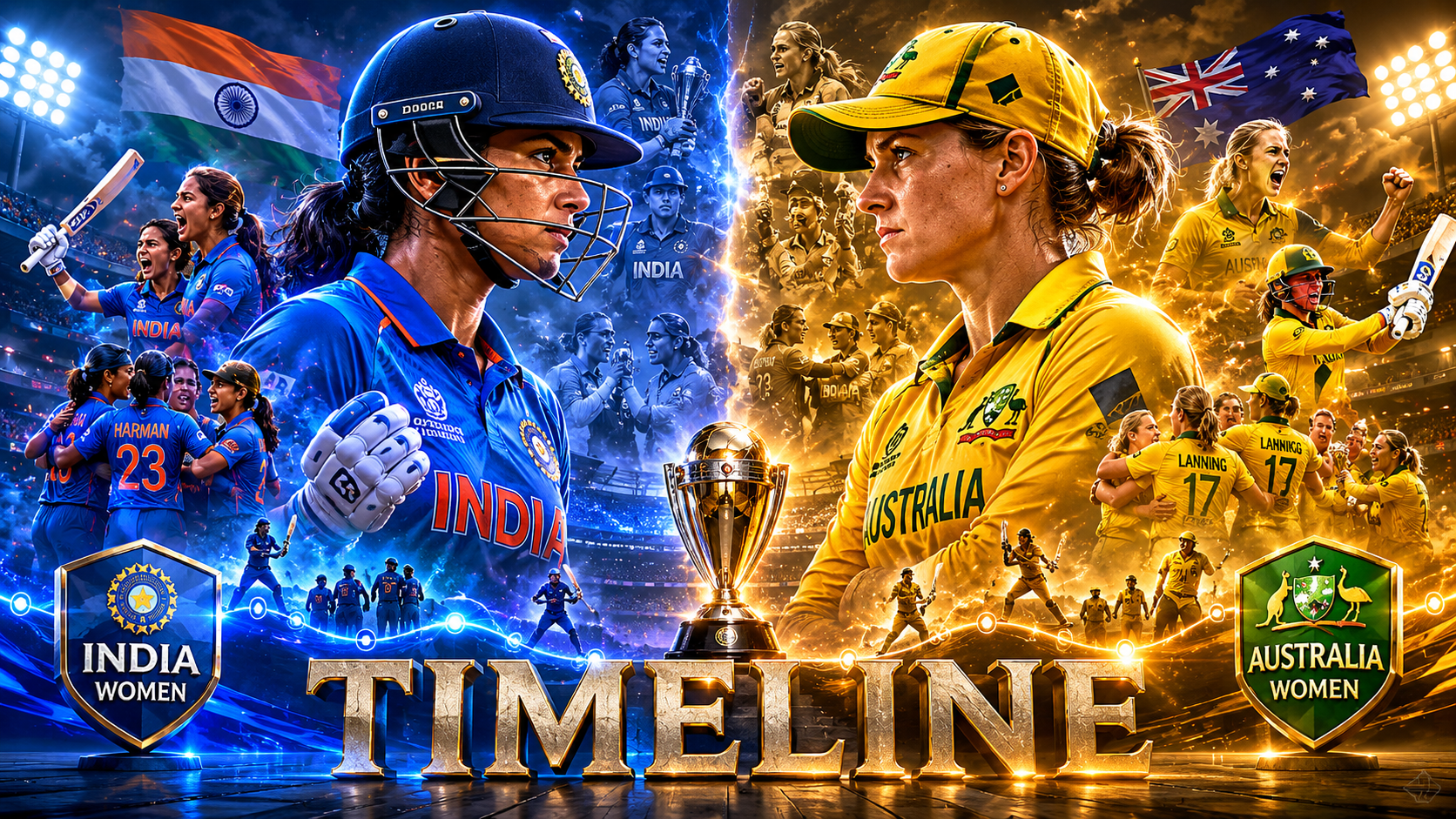
Table of Contents
The rivalry between the India Women’s National Cricket Team and the Australia Women’s National Cricket Team is one of the most compelling stories in women’s cricket. Combining Australia’s dominance with India’s resilience and growth, this timeline highlights iconic clashes, evolving competitiveness, and unforgettable moments that shaped the modern women’s game
Recent Matches Table
| Date | Format | Venue | Winner | Margin |
| Mar 05, 2026 | Test | Hobart | Australia | 10 wickets |
| Mar 01, 2026 | ODI | Hobart | Australia | 185 runs |
| Feb 27, 2026 | ODI | Hobart | Australia | 5 wickets |
| Feb 24, 2026 | ODI | Brisbane | Australia | 6 wickets |
| Feb 21, 2026 | T20I | Adelaide | India | 17 runs |
Top 5 Standout Performances Table
| Player | Team | Performance | Match/Series |
| Harmanpreet Kaur | India | 171* (115) | 2017 World Cup Semi-final |
| Alyssa Healy | Australia | 142 (111) | 2025 World Cup |
| Jemimah Rodrigues | India | 127* (114) | 2025 World Cup Semi-final |
| Jhulan Goswami | India | 5/11 | 2012 T20I Series |
| Deepti Sharma | India | 5/38 | 2023 ODI Series |
Year-wise Key Matches Timeline Table
| Year | Match/Tournament | Notable Highlight |
| 1977 | Test Series | First-ever Test encounter between the two nations |
| 1997 | World Cup | Australia’s Belinda Clark scores a double century (229*) |
| 2005 | World Cup Final | India’s first World Cup final; Australia wins by 98 runs |
| 2017 | World Cup Semi-final | India defeats Australia; Harmanpreet Kaur scores 171* |
| 2025 | World Cup Semi-final | India chases 339 for a record-breaking win over Australia |
Biggest Wins & Closest Matches Timeline Table
| Type | Winner | Margin | Match Date |
| Largest Win (Runs) | Australia | 185 runs | Mar 01, 2026 |
| Largest Win (India) | India | 102 runs | Sep 17, 2025 |
| Closest Win (Runs) | Australia | 5 runs | Feb 23, 2023 |
| Closest Win (Wickets) | Australia | 3 wickets | Oct 12, 2025 |
| Closest Win (Tied) | Tie | Super Over | Dec 11, 2022 |
Should we look into a player-specific statistical comparison for the top all-rounders from both teams?
.
Early Encounters: Australia’s Strong Foundation (1970s–1990s)
In the early years of women’s international cricket, Australia established itself as a dominant force. Their structured system, experienced players, and consistent performances gave them a clear advantage over India. India, still developing its women’s cricket framework, faced challenges in matching Australia’s depth and professionalism. Matches during this period were often one-sided, with Australia controlling the game through strong batting and disciplined bowling. However, India showed determination and gradual improvement, laying the groundwork for future competitiveness. These early encounters were crucial for India’s growth, even though Australia maintained dominance.
| Year | Event | Winner | Venue |
| 1978 | Bilateral Series | Australia | India |
| 1984 | ODI Match | Australia | Australia |
| 1995 | Series | Australia | Neutral |
Building Strength: India’s Gradual Rise (2000–2010)
The early 2000s marked a period of growth for India’s women’s team. With better training, increased exposure, and improved talent development, India began to challenge stronger teams like Australia. While Australia still dominated most matches, India started producing competitive performances. Matches became more engaging, with India showing resilience and fighting spirit. This phase marked the beginning of a shift in the rivalry, as India slowly closed the gap and gained confidence on the international stage.
| Year | Series/Event | Winner | Highlight |
| 2003 | ODI Series | Australia | Strong Performance |
| 2005 | World Cup | Australia | Competitive Matches |
| 2010 | T20 Match | Australia | Close Contest |
Turning Point: India’s Breakthrough Moments (2011–2017)
Between 2011 and 2017, India achieved significant milestones that reshaped the rivalry. Their improved batting lineup and disciplined bowling allowed them to compete more effectively against Australia. A major highlight was India reaching the final of the 2017 ICC Women’s World Cup, showcasing their ability to perform at the highest level. Matches against Australia became more competitive, with India securing important victories. This period marked India’s transition from underdogs to serious contenders in women’s cricket.
| Year | Event | Winner | Highlight |
| 2013 | ODI Series | Australia | Strong Contest |
| 2016 | T20 Series | India | Key Victory |
| 2017 | World Cup | England | India’s Final Run |
Fierce Battles: High-Intensity Rivalry (2018–2021)
This era saw the rivalry reach new levels of intensity. Both teams produced thrilling matches filled with drama and high-quality cricket. Australia remained a dominant force globally, but India consistently challenged them with strong performances. The matches were often closely contested, showcasing the growing competitiveness of women’s cricket. This period highlighted the skill, determination, and professionalism of both teams, elevating the rivalry’s global appeal.
| Year | Series/Event | Winner | Highlight |
| 2018 | T20 Series | Australia | Competitive Games |
| 2020 | T20 World Cup | Australia | Final Victory |
| 2021 | ODI Series | Australia | Close Matches |
Modern Era: Competitive and Evolving (2022–Present)
In recent years, the rivalry has become more balanced and unpredictable. India’s growing depth and Australia’s continued excellence have created exciting contests. Matches are often decided by small margins, reflecting the narrow gap between the teams. Both sides continue to develop new talent, ensuring the rivalry remains dynamic and engaging. This phase represents the modern evolution of women’s cricket, where competition is fierce and standards are continually rising.
| Year | Series/Event | Winner | Highlight |
| 2022 | Commonwealth Games | Australia | Gold Medal |
| 2023 | Bilateral Series | Australia | Tight Wins |
| 2024 | Recent Matches | — | Balanced Rivalry |
Star Players Who Defined the Rivalry
This rivalry has been shaped by exceptional players who delivered memorable performances. India has relied on stars like Mithali Raj and Harmanpreet Kaur, while Australia has been led by legends such as Meg Lanning and Ellyse Perry. Their contributions have defined key moments and elevated the rivalry to global prominence.
| Player | Team | Role | Contribution |
| Mithali Raj | India | Batswoman | Consistency |
| Harmanpreet Kaur | India | Batter | Match Winner |
| Meg Lanning | Australia | Batter | Leadership |
| Ellyse Perry | Australia | All-rounder | Versatility |
Future Outlook: A Rivalry Shaping Women’s Cricket
The future of this rivalry looks incredibly promising. India continues to develop emerging talent, while Australia maintains its strong cricketing system. As both teams evolve, their encounters are expected to become even more competitive. This rivalry not only entertains fans but also plays a crucial role in promoting women’s cricket globally. With each match, the intensity and quality of competition continue to rise.
| Aspect | India | Australia | Impact |
| Strength | Batting Depth | Balanced Squad | High-Quality Matches |
| Challenge | Consistency | Maintaining Dominance | Close Games |
| Future | Emerging Talent | Strong System | Exciting Rivalry |
Conclusion
The timeline of the India Women’s National Cricket Team vs Australia Women’s National Cricket Team rivalry reflects a journey of growth, dominance, and rising competition. Australia’s early supremacy has been challenged by India’s steady progress, creating a thrilling and evolving contest. Both teams have contributed to some of the most memorable moments in women’s cricket. As the rivalry continues, it promises even greater excitement and competitiveness. This contest stands as a symbol of the rapid development of women’s cricket, inspiring future generations and showcasing the skill, passion, and determination of players on the global stage.
FAQs
Q1. When did India Women and Australia Women first play against each other?
India Women and Australia Women first met in international cricket during the 1970s, starting a rivalry that has continued across all formats.
Q2. Which team has a better head-to-head record?
Australia Women hold the advantage in the overall head-to-head record and are one of the most successful teams in women’s cricket history.
Q3. What is the most memorable match in this rivalry?
The 2020 ICC Women’s T20 World Cup Final is considered one of the most memorable encounters between the two teams.
Q4. Have India Women defeated Australia Women in ICC tournaments?
Yes, India Women have recorded important victories over Australia Women in major ICC competitions.
Q5. Who are some notable players in this rivalry?
Mithali Raj, Harmanpreet Kaur, Smriti Mandhana, Ellyse Perry, Alyssa Healy, and Meg Lanning are among the standout players.
Q6. Which format has produced the closest contests?
ODI and T20I cricket have produced several thrilling matches between the two teams.
Q7. What makes Australia Women a strong opponent?
Australia Women are known for their batting depth, experienced bowlers, and consistent performances in major tournaments.
Q8. How has India Women improved in this rivalry?
India Women have strengthened their squad through talented young players and increased international experience.
Q9. Why is this rivalry important for women’s cricket?
It showcases some of the world’s best female cricketers and helps promote the growth of women’s cricket globally.
Q10. Why do fans enjoy India Women vs Australia Women matches?
The matches often feature high-quality performances, competitive cricket, and exciting finishes.




Post Comment